


Originally conceived in 1924 to celebrate the expansion of Macy’s Herald Square flagship and mark the beginning of the holiday shopping season, the inaugural parade attracted an estimated 250,000 spectators. Featuring marching bands, elaborate floats and live animals borrowed from the Central Park Zoo, it was an ambitious exercise in experiential marketing.
The introduction of Felix the Cat in 1927, followed by Mickey Mouse in 1934, marked the beginning of what would become one of the world’s most recognizable showcases for character intellectual property. A hundred parades later, what began as a promotional event for a department store has evolved into a sophisticated commercial ecosystem spanning media rights, brand sponsorship, character licensing, consumer products and experiential entertainment.
When brands entered the parade
The emergence of corporate-sponsored floats and balloons in the early 1950s marked an important evolution in the commercial model of the parade. The arrival of national television coverage in 1953 dramatically expanded the potential audience, making participation an increasingly attractive proposition for consumer brands and entertainment companies alike.
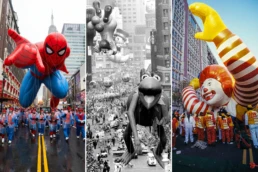
Over subsequent decades, characters such as the Pillsbury Doughboy, Ronald McDonald and Sinclair Oil’s dinosaur joined established entertainment properties in the skies above Manhattan.
The parade was no longer exclusively a vehicle for promoting Macy’s; it had become a platform through which other businesses could introduce their characters to new audiences, reinforce brand recognition and support broader commercial initiatives.
For IP owners, this introduced an interesting dimension to their licensing strategies: the value of adapting a character into an entirely new format, not necessarily to generate direct licensing revenue, but to stimulate demand across other licensed product categories.
Flipping the royalty model
In a traditional character licensing arrangement, a licensee pays an IP owner for the right to commercially exploit its intellectual property. A toy manufacturer, apparel company or video game developer might pay royalties in exchange for the right to incorporate a recognizable character into its products. The Macy’s Thanksgiving Day Parade effectively flips that commercial dynamic.
Rather than receiving payment for the use of their characters, participating brands invest in having their IP reimagined, designed and constructed by Macy’s Parade Studio, before being flown down the streets of Manhattan.
Historically reported costs put participation with a new character balloon at approximately $190,000, with returning balloons estimated at around $90,000. Additional promotional and retail activations can increase that investment considerably.
Why would an IP owner pay for someone else to use its intellectual property? Consider the alternative.
In 2025, premium 30-second advertising spots during the parade reportedly commanded prices of up to $900,000. A character balloon offers a different form of exposure: one in which the IP becomes part of the entertainment itself rather than an interruption to it.
The commercial return is realized elsewhere, through merchandise sales, licensing royalties, content consumption, theatrical admissions and other extensions of the brand.
When the retailer becomes the rights holder
Perhaps the most interesting new character appearing in this year’s parade belongs to Macy’s itself. Developed internally by Macy’s Studios, Billie Brightpaw is an original character whose design draws directly from the retailer’s corporate heritage, with a magical red star on her paw inspired by Macy’s iconic logo. But Billie’s launch extends well beyond her appearance in the parade.
Ahead of her Thanksgiving debut, Macy’s introduced an exclusive consumer products collection spanning plush toys, Christmas ornaments, collectible pins, notebooks and bag charms, alongside commemorative apparel and accessories. With products ranging from $20 ornaments to $150 varsity jackets in the broader collection, Macy’s has created multiple opportunities for consumers to engage with its newest character and the parade itself. On Black Friday, Billie will also come to life as an interactive puppet experience at Herald Square, extending the character from consumer products into experiential retail.
What makes this particularly interesting is the degree of control Macy’s exercises over the IP value chain. From character development and storytelling to media exposure, retail distribution, and live entertainment, Macy’s controls much of the infrastructure required to establish and monetize a new character brand.
The business behind the balloons
What began in 1924 as a promotional event for a department store has become an extraordinarily valuable piece of intellectual property in its own right. Advertising revenue for the 100th Macy’s Thanksgiving Day Parade is projected to exceed $100 million, while a new ten-year media rights agreement covering the parade and other Macy’s events is reportedly worth as much as $600 million.
For the IP owners participating in the parade, the economics are equally compelling. With historically reported participation fees of around $190,000 for a new balloon, brands gain the opportunity to showcase their characters to an audience of more than 35 million television and streaming viewers, not to mention millions of spectators lining the streets of Manhattan. But the real opportunity lies in what happens after the balloons come down.
Exclusive merchandise collections, new licensing partnerships, theatrical releases, streaming subscriptions and theme park visits all provide avenues through which rights holders can convert that exposure into revenue. And with the parade taking place on the eve of Black Friday, the journey from brand awareness to consumer purchase can be remarkably short.
For Macy’s, the parade itself has become a monetizable entertainment property. For the brands represented in it, it has become a platform for establishing and revitalizing valuable intellectual property. A hundred parades later, the most interesting thing about the balloons may not be how high they fly, but how far the IP behind them can travel.